
The 50-50 partnership would bring together BSE's closely watched India index suite, which includes the Sensex, with S&P Dow Jones Indices' 115 years of experience in publishing transparent and independent global benchmarks.

S&P Dow Jones has said it will remove Adani Group's flagship firm Adani Enterprises from sustainability indices with effect from February 7 following a media and stakeholder analysis triggered by allegations of accounting fraud. The move comes amid leading stock exchanges BSE and NSE putting three Adani Group companies -- Adani Enterprises, Adani Ports and Special Economic Zone and Ambuja Cements -- under their short-term additional surveillance measure (ASM) framework. "Adani Enterprises will be removed from the Dow Jones sustainability indices following a media and stakeholder analysis triggered by allegations of accounting fraud," S&P Dow Jones Indices said in a statement.

Post partnership with S&P, the exchange is looking at launching a slew of international products, too.

Domestic bourse BSE has approved the acquisition of a 50 per cent stake in index provider Asia Index (AIPL) from equal joint venture partner S&P Dow Jones (SPDJ) Indices for Rs 30 crore. AIPL, the index provider, is responsible for compiling and maintaining the widely followed Sensex, Bankex, and other indices. Passive funds with assets of nearly Rs 2 trillion are benchmarked with indices provided by AIPL.

Rupee-denominated contracts will be traded from 9 am to 5 pm.
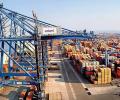
Gautam Adani-owned Adani Ports and Special Economic Zone (APSEZ) will replace IT major Wipro in the 30-share BSE Sensex from June 24, according to an official announcement on Friday. This marks the first inclusion of any Adani Group firm in Sensex. The group has 10 listed firms with a combined market valuation surpassing Rs 17 lakh crore.

Asset-weighted returns of large cap funds lagged their benchmark by 273 basis points, ELSS funds by 318 bps and mid- and small-cap funds by 230 bps.
S&P Dow Jones Indices on Tuesday said it will remove Adani Ports and Special Economic Zone from its sustainability index following reports of its business ties with Myanmar's military that has been accused of human rights violations after a coup. The Adani Group firm is building a $290 million port in Yangon. In a statement, S&P Dow Jones Indices said: "Adani Ports and Special Economic Zone will be removed from the Dow Jones Sustainability Indices following a media and stakeholder analysis triggered by recent news events pointing to heightened risks to the company regarding their commercial relationship with Myanmar's military, who are alleged to have committed serious human rights abuses under international law."
Leading stock exchange BSE on Tuesday postponed the removal of Jio Financial Services Ltd, the demerged non-banking financial services unit of Mukesh Ambani-led Reliance group, from all the S&P BSE Indices to August 29. Earlier, the stock was scheduled to be removed from the indices on August 24. Jio Financial Services Ltd (JFSL) got listed on the bourses on Monday and hit the lower circuit for the second day in a row on Tuesday.

The Congress-led opposition stepped up its attack on Friday against the government over the Adani row and demanded that there should be a thorough investigation into what they alleged was a 'mega scam' as it involved public money.

Investors might soon get to bet on various versions of the Bombay Stock Exchange's (BSE) benchmark index, the Sensex, and its other key gauges soon.

Fund managers of large-cap and equity-linked saving schemes (ELSS) have demonstrated a marked improvement in their performance over the past year, according to the latest SPIVA (S&P Indices Versus Active) report released by S&P Dow Jones Indices. In the one-year period ending June 2023, 17 per cent of active large-cap schemes outperformed the S&P BSE 100, compared to just 9 per cent at the end of June 2022. In the case of ELSS, there was a sharp improvement in performance, with 66 per cent of active schemes delivering better returns than the benchmark S&P BSE 200.

Proceedings in both Lok Sabha and Rajya Sabha were disrupted as Opposition members raised slogans demanding a discussion and a Joint Parliamentary Committee (JPC) probe into the fraud-allegation-triggered rout.
In a major development that will allow Indian investors access to the American market, the National Stock Exchange (NSE) has decided to begin trading in futures contracts of S&P 500 and Dow Jones Industrial Average (DJIA), two of the world's most influential market indices.

Over 87 per cent of active large-cap schemes failed to outperform the benchmark S&P BSE 100 (total return) in the 2022 calendar year (CY), significantly higher than the 2021 figure of 50 per cent, shows a report by S&P Dow Jones Indices. During the three-year period (CY 2020, '21, '22), the percentage of schemes underperforming the index was even higher at 97 per cent. While active large-cap schemes generally find it tough to outperform due to a rising efficiency in the market, 2022 proved to be even more challenging as mid-cap and small-cap stocks (where they have some allocation) performed poorly vis-a-vis the large-caps.
The issue of allowing trading in indices such as the Dow Jones and the S&P 500 on the National Stock Exchange (NSE) is being considered by the Reserve Bank of India (RBI).

Sebi will soon put in place new norms for changes in constituents of the key stock market indices.

As per the new methodology, stocks must have an annualised traded value of at least Rs 1,000 crore for their inclusion in the BSE 100 index at each semi-annual rebalancing

Sahai, who did his master's in economics from the University of Delhi, is currently head of Citi's Securities and Fund Services business.

Two firms belonging to the Adani group - India's most valued conglomerate - are part of the Nifty 50 index. The group, however, has no representation in the Sensex. And it could stay this way if a proposed index qualification rule change gets approved. Recently, Asia Index, a joint venture between S&P Dow Jones Indices and BSE responsible for index composition, floated a consultation paper where it proposed that a stock must have a derivative contract to be eligible for inclusion in the flagship 30-share Sensex index.

Both the debt and equity markets have seen sharp volatility in recent months.

Investors should use a mix of active and passive funds.

Domestic benchmark equity indices may see a positive trading sentiment on Friday thanks to a spectacular rally in world markets after the US President Donald Trump announced to put tariff hikes on hold for 90 days, excluding China from the reprieve. Indian stock markets were closed on Thursday for Shri Mahavir Jayanti. Trump has declared a three-month pause on reciprocal tariffs on non-retaliating countries marking a rather unexpected U-turn after record high levies he imposed led to global stock market meltdown.

United States President Donald Trump on Sunday warned of new and significantly higher tariffs on Chinese goods if Beijing does not withdraw a recent 34 per cent retaliatory tariff hike, threatening to end all ongoing talks with China.

After equity indices of emerging markets, Indian investors will now be able to trade the key index of the UK. The National Stock Exchange (NSE) will launch trading in the FTSE 100, the UK's benchmark equity gauge, from May 3.

Major global indices - the Nasdaq, Bovespa, Seoul Composite, S&P 500, Dow Jones, S&P BSE Sensex, NYSE, DAX, Nikkei and, CAC 40 - have all gained 37 per cent to 75 per cent since their respective March 2020 low.

On the lines of Shariah-compliant products, intermediaries ask exchanges to consider investment benchmark.
Benchmark indices Sensex and Nifty declined in early trade on Wednesday due to selling in financials, oil and IT stocks amid weak global trends.

Investors' wealth eroded by more than Rs 2.21 lakh crore in early trade on Wednesday, with the market witnessing a selling-off amid prospects of aggressive rate hikes by the US Federal Reserve to tackle high inflation, and sluggish global trends. In less than an hour of the start of trading on Wednesday, the key indices -- Sensex and Nifty -- were deep in the red and witnessed significant volatility, reflecting jittery investor sentiments. The market capitalisation of BSE-listed companies, which is also an indicator of wealth of investors, tumbled more than Rs 2.21 lakh crore to Rs 2,84,49,727.56 crore amid the 30-share Sensex falling 564.76 points to 60,006.32 points.
Fund managers's compensation is largely tied to the assets they manage and scheme performance.

Infosys slipped nearly 9% after the company cut full year revenue outlook for FY17.

For a time it looked as if Apple would never relinquish the top spot in terms of market value.

Among Sensex shares, HDFC Bank fell the most by 2.58 per cent, followed by SBI (2.12 per cent), HDFC (2.09 per cent), and IndusInd Bank (2.02 per cent). Axis Bank, Bajaj Finserv, M&M, L&T, Reliance, Infosys and TCS were among the major losers. In contrast, Tata Motors, Maruti, NTPC, Sun Pharma, Power Grid and Titan were among the gainers.

The Dow has never lost more than 800 points in a day.


Benchmark Sensex trimmed early gains to close marginally higher while Nifty settled flat in choppy trade on Tuesday as gains in auto shares were offset by selling pressure in banking and energy shares. The 30-share BSE barometer closed marginally up by 37.08 points or 0.06 per cent to 60,978.75 with 15 of its stocks ending in green and the rest in red. The index opened higher and gained over 300 points to a high of 61,266.06 in early trade.

M&M was the biggest loser in the Sensex chart, falling 6.39 per cent, followed by Tech Mahindra, Nestle India, Bajaj Finance, Axis Bank, ITC, JSW Steel, HDFC Bank and RIL. On the other hand, Sun Pharma, Tata Motors, Bharti Airtel, L&T and Infosys were among the winners, rising up to 2.10 per cent.

Monday's drop followed an 8.5 per cent slump in Chinese markets.

From the 30-share pack, Asian Paints, Reliance Industries Limited, Bajaj Finance, Mahindra & Mahindra, Indusind Bank, Bajaj Finserv, Maruti Suzuki, HDFC Bank and UltraTech Cement were the major gainers, jumping up to 5.56 per cent.

Five Indian-origin women executives have made it to Barron's prestigious annual '100 Most Influential Women in US Finance' list for achieving positions of prominence in the financial services industry and helping shape its future. Barron's is a sister publication of the Wall Street Journal, published by Dow Jones and Company. "The list honours established and emerging leaders in financial services, the corporate world, nonprofit organisations, and government," the magazine said in a press release.
 © 2026 Rediff.com - Advertise with us - Disclaimer - Privacy Policy - Sitemap - Feedback - About us - Terms of use - Grievances